This document describes all of the steps and components required to create a custom Animation Rig. This video also demonstrates the process.
Once you have added a Rig Builder component to an animatable hierarchy's root GameObject, you can create a Rig GameObject as a child of this root

. To enable animation rigging, the Rig GameObject must have a Rig component. To then connect the Rig to the Animator, you must assign this Rig component to a Rig Layer on the Rig Builder component.
Rigging Edge Cases
After you connect the Rig GameObject to the Rig Builder component, you can add rig elements (i.e., GameObjects with Constraint components) under the Rig GameObject hierarchy. Different rig elements can be organized and hierarchically structured to accommodate any rigging requirement.
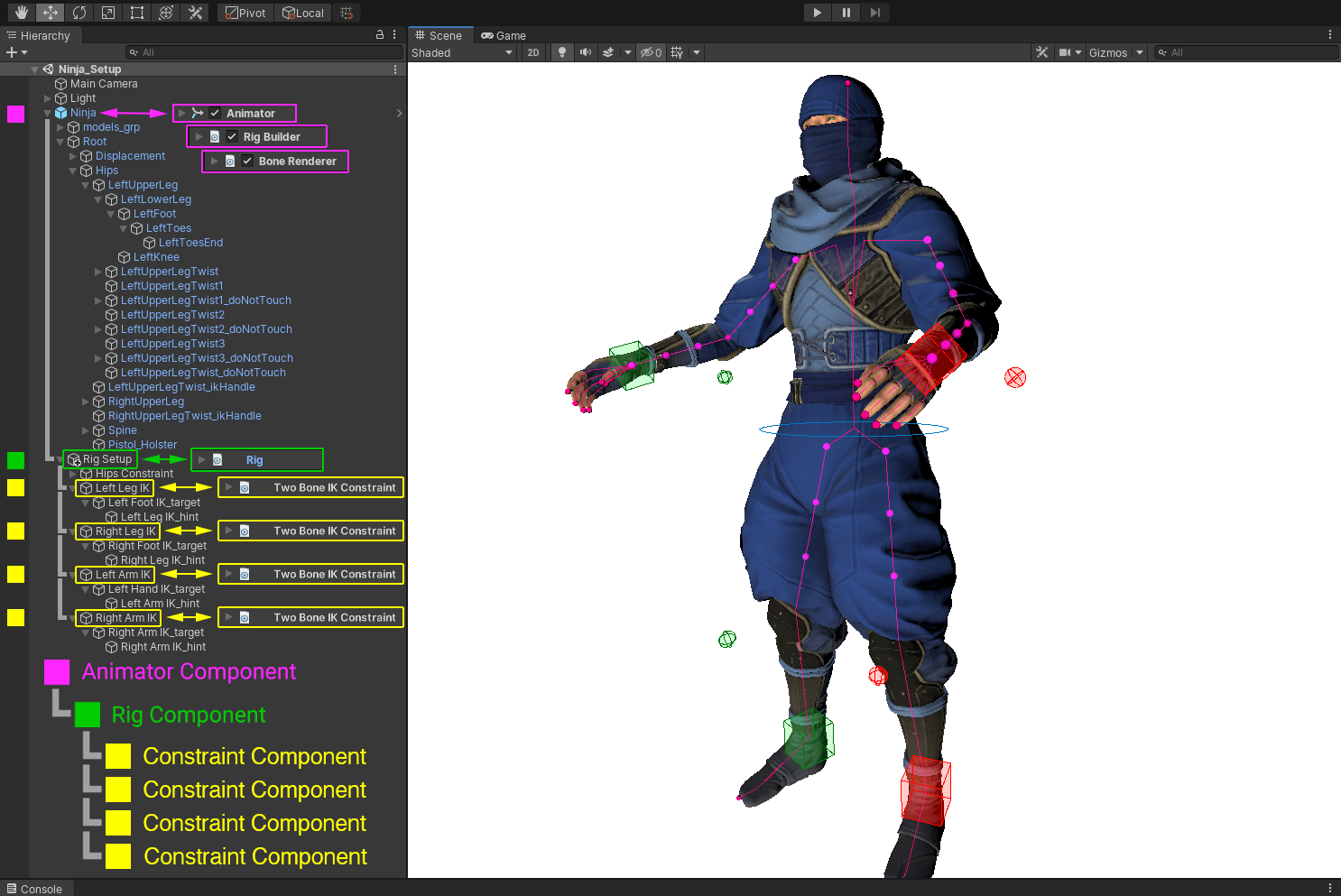
Source objects for Constraints, such as Target Effectors or Hint Effectors, can be placed under their associated Rig GameObject. In the following illustration,
The Rig Builder component lives alongside the Animator component and creates a Playable Graph that is appended to the existing Animator state machine. The Rig Builder component needs to be added to the GameObject that has the Animator component. Rig Builder needs to affect the same hierarchy as the Animator.
Animating Hand Poses In Unity
The Rig component is the main entry point for all Constraints in a given control rig. Note there should only be one Rig component per control rig hierarchy, which you must assign to a Rig Layer on the Rig Builder component. To use multiple control rigs with a single hierarchy, you must assign each Rig to a different Rig Layer, and enable/disable them independently.
From a technical standpoint, the main purpose of a Rig component is to collect all Constraint components in its local hierarchy. The component generates an ordered list of
, and so the order of components in the Rig's hierarchy determines the evaluation order of the jobs. This method follows depth-first traversal as shown below:
How To Properly Setup Animation Rigging For Procedural Animation In Unity?
In other words, grouping constraints under a GameObject allows you to manage the evaluation order of these constraints by modifying the hierarchy.
Control rig hierarchies should hold all the necessary rig elements such as effectors, constraints, and other objects/elements required by the constraint definitions. The root of a control rig hierarchy should be at the same level as the skeleton root, both under the Game Object holding the Animator.
Rig components, like all Constraint components, have a Weight property that can be used, animated, and scripted to enable/disable or ease-in/ease-out an entire control rig hierarchy.
Free 3d Character And Facial Animation From Unity
The Bone Renderer component allows you to define a transform hierarchy to be drawn as bones for visualization and selection during the rigging process. These bones are not visible in the Game view. This allows you to define your character deformation skeletons for rigging purposes.
You can customize the appearance of the bones by modifying Bone Size, Shape and Color. The package provides these default shapes: Line, Pyramid, and Box. You can also display tripods of local axes and adjust their size to suit your preference.

Similarly to bones, Rig Effectors allow you to add gizmos to transforms for visualization and selection. You can add them to any transform in the same hierarchy as a Rig Builder or Rig component. Like bones, Effectors are not visible in the Game view. A special Scene View overlay allows you to manage and customize effectors in the Rig hierarchy.
Rigging A Sprite With The 2d Animation Package
You can also customize the appearance of the effectors by modifying Effector Size, Shape, Color, Offset Position and Offset Rotation. The shape can be any Mesh asset available in the project. You can create, delete, or edit multiple effectors at once.
When a specific GameObject in your rig's hierarchy is important for manipulation but not referenced by any rig constraints, you must add a RigTransform component, found undeAnimation Rigging allows the user to create and organize different sets of constraints based on the C# Animation Jobs API to address different requirements related to animation rigging. This includes deform rigs (procedural secondary animation) for such things as character armor, accessories and much more. World interaction rigs (IK, Aim, etc.) for interactive adjustments, targeting, animation compression correction, and so on.
The following sections present required components and steps to take in order to define an Animation Rig. This video also demonstrates package component usage to create a custom Animation Rig.
How To Animate Your Avatar For Vr In Unity
The Rig Builder component lives alongside the Animator component and creates a Playable Graph that is appended to the existing Animator state machine. The Rig Builder component needs to be added to the GameObject that has the Animator component. Rig Builder needs to affect the same hierarchy as the Animator.
The Bone Renderer component allows the user to define a transforms hierarchy to be drawn as bones for visualization and selection during the rigging process. These bones are not visible in the Game view. This, for example, allows the user to define his character deform skeleton for rigging purposes.
The look of the bones can be customized. The Bone Size, Shape and Color can be modified. Tripods of local axes can also be displayed and their size adjusted to accommodate user preference. The user can choose from one of the default looks; Pyramid, Line or Box.
Rigging A Character Imported With The Psd Importer
Similarly to bones, Rig Effectors allow the user to add visual gizmos to transforms for visualization and selection. These can be added to any transform in the same hierarchy as the Rig Builder or Rig component. Effectors are not visible in the Game view. A special Scene View overlay has been added to manage and customize effectors in the Rig hierarchy.
The look of the effectors can also be customized. The Effector Size, Shape, Color, Offset Position and Offset Rotation can be modified. The shape can be any Mesh asset available in the project. Multiple effectors can be created, deleted and edited at once.
The Rig component is the main entry point to all rig constraints for a given Rig. This component is assigned to a Rig Builder component under the Rig Layer field. There should only be one Rig component per control rig hierarchy. For multiple rigs, multiple control rig hierarchies can be assigned to different Rig Layers, and enabled/disabled independently. The main purpose of the Rig component is to collect all Constraint components defined under its local hierarchy and generate an ordered list (evaluation order) of
Using The Animation Rigging .. How To Rig The Hip Properly For Both Foot And Hip
, which will then be applied after the Animator evaluation. The order in which the jobs are evaluated is defined by component order and the way the rig hierarchy is constructed, since constraints are gathered using
In other words, grouping constraints under a GameObject allows the user to the manage the evaluation order of these constraints by modifying the hierarchy.

Control rig hierarchies should hold all the necessary rig elements such as effectors, constraints, and other objects/elements required by the constraint definitions. The root of a control rig hierarchy should be at the same level as the skeleton root, both under the Game Object holding the Animator. In other words, it should not be in the skeleton hierarchy, but rather live beside it.
Unityのanimation Riggingでik/fk切り替えスライダ付きのtwo Bone Ikコンストレイントを作成する
Rig components, like all Constraint components, have a Weight property that can be used, animated, and scripted to enable/disable or ease-in/ease-out an entire control rig hierarchy.
When a specific GameObject part of your rig hierarchy is important for manipulation but not referenced by any rig constraints, you'll want to add the RigTransform component which is found under
A Rig is a hierarchy of GameObjects using a minimum of these three components; Rig Builder, Rig + Constraint(s). A typical setup is to have a hierarchy of GameObjects [ex: Ninja.fbx] containing an Animator component on his root GameObject. To make this hierarchy available to the Animation Rig, the Rig Builder component is required. Once the Rig Builder component is added to the root, a
Setting Up An Ik Weapon System In Unity! (1)
Holding the Rig component is connected to the Rig Builder component, rig elements (effector GameObjects) that hold rig Constraint components can be added under the
Hierarchy. Different rig elements can be organized and hierarchically structured to create any kind of Rig, in order to accommodate any rigging requirement. Source GameObjects for Constraints, such as Target Effectors or Hint Effectors, can be placed under their associated

. In the following illustration, the Left Leg is acting as the Rig element that contains a Two Bone IK Constraint component which is at the same time the parent of both LeftFootEffector and LeftLegHint source objects.
0 Response to "Animation Rigging Unity"
Posting Komentar