Bec Crew is a Sydney-based science communicator with a love for weird and wonderful animals. From strange behaviours and special adaptations to newly discovered species and the researchers who find them, her topics celebrate how alien yet relatable so many of the creatures that live amongst us can be.
Like a white chocolate and caramel puff the size of a house cat, this species is wrapped in an incredibly beautiful coat, the females in an overall creamy colour with a ginger face, and the males ginger all over with a network of white splotches arranged like dappled sunlight.
This striking coat is what makes the spotted cuscus one of the world’s prettiest marsupials, but it also makes it stand out like a beacon in the forest canopy.
Mountain Cuscus In Papua New Guinea Stock Photo
With nothing but claws, teeth, and some kicky back legs to defend itself, the cuscus is easy prey for large birds like the Papuan eagle, tree pythons, and yes, humans.
One strategy to hide itself is a nocturnal lifestyle, but how does it keep out of sight in the light of day?
In 2002, ecologist Thomas Heinsohn from the Australian National University visited New Ireland, a large island off the east coast of Papua New Guinea. Here he met an adult male spotted cuscus sleeping in a coconut palm.
Stop The Deforestation Of Woodlark Island!
Cuscuses don’t curl themselves up in tree hollows like other possums do, so Heinsohn could spot it resting between the branches, about 12m up, with its head tucked between its legs in typical cuscus sleeping fashion. Curiously though, it looked like a palm frond had been deliberately pulled down and tucked around its body, obscuring the brightest shades of its coat.
“During steady observation through binoculars over the next hour, the resting cuscus was observed to actively grab hanging palm frond pinnae with its forepaws, pull them in towards itself, and tuck them in around its body to improve its quite effective camouflaging shield of vegetation, ” Heinsohn reported in the journal Australian Mammology. “Eventually only patches of its bright white and ginger-red spotted pelage were visible with the aid of binoculars through gaps in the camouflaging foliage.”
So this adorable golden possum sleeps in trees with its head between its legs, wrapped in leaves like a cool green blanket.
Cute Animal Picture Of The Day: The Little Known Cuscus
Discovered just 10 years ago, this extremely rare species somehow ended up with the most stunning pale blue eyes. Classified as critically endangered almost as soon as it was named, this species has so far eluded every recent survey to find a single individual in the wild.
Ouch, my heart: the Mareeba rock wallaby Meet the adorable Mareeba rock wallaby (Petrogale mareeba), found in just one place in the world.
Hydrosaurus lizards look like old-timey dinosaurs Remember, back in the day, when all of our dinosaur toys looked like this beautifully posed Hydrosaurus lizard?
Adw: Spilocuscus Rufoniger: Information
EOFY Sale - Up to 30% off Save big on a wide selection of items on the Australian Geographic Shop. Shop Now
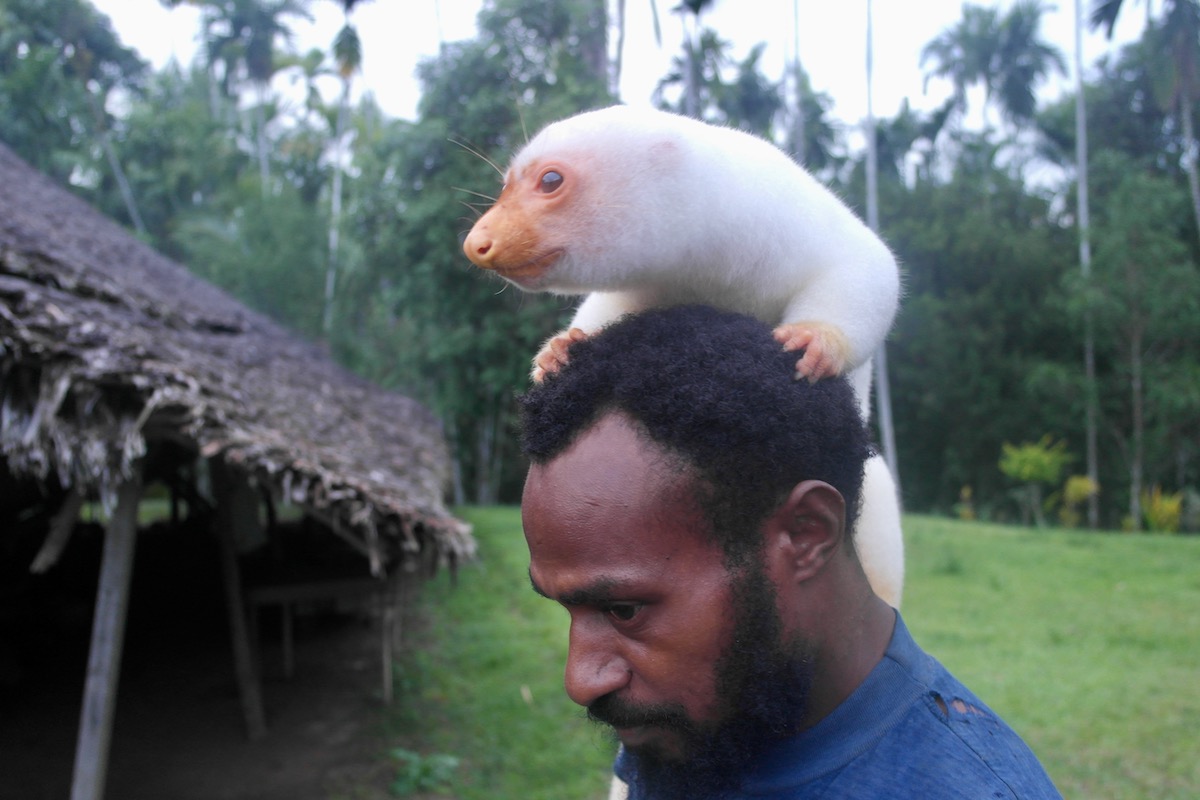
In stock now: Hansa Soft Toys and Puppets From cuddly companions to realistic native Australian wildlife, the range also includes puppets that move and feel like real animals. Shop NowNot so many moons ago I stayed with a tribe in Papua New Guinea in the jungle of Madang. The tribe kept quite possibly the oddest, most unique-looking animal that I have seen so far on my travels. it’s hard to explain, but luckily I took photos – the closest-looking thing to the cuscus animal (AKA ‘Common Spotted Cuscus) that I had personally witnessed was a sloth in Costa Rica, although they aren’t related.

I figured that the tribe were keeping it for meat, but it turned out to be their pet after a mixture of superstition and concerns over the emblematic animal’s welfare in the rainforest. When I got back to ‘the real world, ’ I got the kettle on and read up on this cute, elusive creature.
Wildlife Of Papua New Guinea
“Because it’s beautiful the people who live in this region have been using it for a ceremonial dress for thousands of years.”
11. Although they are generally shy creatures, the male cuscus can become extremely aggressive with another male cuscus. They spit on branches and twigs of trees to inform others of their territory and mediate social interactions. If they encounter another male in their area, they make barking, snarling, and hissing noises and stand upright to defend their territories.
12. Cuscuses are sexually prolific all year round with multiple partners. The gestation period for a pregnant female is around 13 days, with a pouch period of 6–7 months. When the babies (usually 2-3 per time) are born, they only weigh around a gram and live in the pouches of their mother, much like in the kangaroo world until they reach maturity. Only one in three tend to survive the full 6-7 months though.
Woodlark Cuscus Phalanger Lullulae
A former loser who took a risk. I now live in Chiang Mai, Thailand after visiting over 100 countries. Stay tuned for the next challenge against that clock!
In November of 2010, I took on a mammoth challenge against the clock in a quest to upgrade my miserable life. I went out of my comfort zone and turned it all around. Ten years later, I’m completely location independent…The common spotted cuscus (Spilocuscus maculatus), also known as the white cuscus, is a cuscus, a marsupial that lives in the Cape York region of Australia, New Guinea, and nearby smaller islands.

The common spotted cuscus is about the size of a common house cat, weighing 1.5 to 6 kilograms (3.3 to 13.2 lb), body size about 35 to 65 ctimetres (14 to 26 in) long, and a tail 32 to 60 ctimetres (13 to 24 in) long.
The Common Spotted Cuscus
It has a round head, small hidd ears, thick fur, and a prehsile tail to aid in climbing. Its eyes range in colour from yellows and oranges to reds, and are slit much like a snake's. All four of its limbs have five digits and strong, curved claws, except the first digit on each foot. The second and third digits of the hind foot are partly syndactylous: they are united by skin at the top joint, but divide at the claws. These smaller claws can serve as hair combs wh cleaning. The first and second digits of the fore foot are opposable to the other three, helping it grip branches while climbing. The undersides of its paws are bare and striated, which also help it grasp trees and food. The first digit on the hind foot is clawless and opposable.
It has thick, woolly fur of varying colours depding on age, sex, and location. Males are typically grey/white or brown/white with splotchy patterns on their back and a white underbelly. Only males have spots.
Females are usually white or grey and unspotted. Some completely white individuals are known in both males and females. As the young grow, they go through a series of color changes before reaching sexual maturity around one year old. Colouration varies from reds and whites to buffs, browns, light greys, and blacks. Unlike some other species of cuscuses or possums, the common spotted cuscus does not have a dorsal stripe on its fur.
Papua New Guinea
The curled, prehsile tail is a distinctive characteristic of the common spotted cuscus. The upper part of the tail closest to the body is covered in fur, while the lower half is covered in rough scales on the inside surface to grip branches.
The common spotted cuscus is typically very shy, so it is rarely se, especially in northern Australia. It is nocturnal, hunting and feeding at night and sleeping during the day on self-made platforms in tree branches. It also has be found resting in tree hollows, under tree roots, or among rocks. It is slow-moving and somewhat sluggish, sometimes mistak for sloths, other possums, or ev monkeys. Unlike its close relatives, the common spotted cuscus has be observed feeding during the day on rare occasions.

The common spotted cuscus is typically a solitary creature, feeding and nesting alone. Interactions with others, especially betwe competing males, can be aggressive and confrontational. Male cuscuses sct mark their territory to warn off other males, emitting a petrating musk odor both from their bodies and sct gland excretions. They distribute saliva on branches and twigs of trees to inform others of their territory and mediate social interactions. If they counter another male in their area, they make barking, snarling, and hissing noises, and stand upright to defd their territories. They are aggressive, and can scratch, bite, and kick pottial predators.
Common Spotted Cuscus & Bird Of Paradise 10 Toea Papua New Guinea Auth
While females have four teats in their pouches and can have up to three young per birth, they rarely suckle more than two.
Each young weighs no more than 1 gram at birth, and is held in the mother's well-developed forward-oping pouch. Cuscuses can live to be 11 years old, and reach sexual maturity around one year old.
The common spotted cuscus lives in rainforests, mangroves, hardwood and eucalypt forests below 1, 200 metres (3, 900 ft); unlike most of its relatives, it is not restricted to rainforest vironmts.
Common Spotted Cuscus (spilocuscus Maculatus)
It is believed that over the past million years there have be waves of migration during periods of low sea levels that
0 Response to "Cuscus Animal Papua New Guinea"
Posting Komentar